The names
Cartujano, Andalusian, PRE: what the names mean
Three names circle the same family of horses. What Carthusian, Andalusian and Pura Raza Española each mean, and what the horses look like.
Book the Carthusian horse visit ↗Quick answer
Andalusian and Pura Raza Española (PRE) name the same horse: the first is the usual name abroad, the second the name used in Spain. Cartujano, or Carthusian, names a bloodline within it, kept by the monks of Jerez and then by the state. It is a historic line, not a genetically separate breed, and it is mostly grey.
Three names, one family of horses
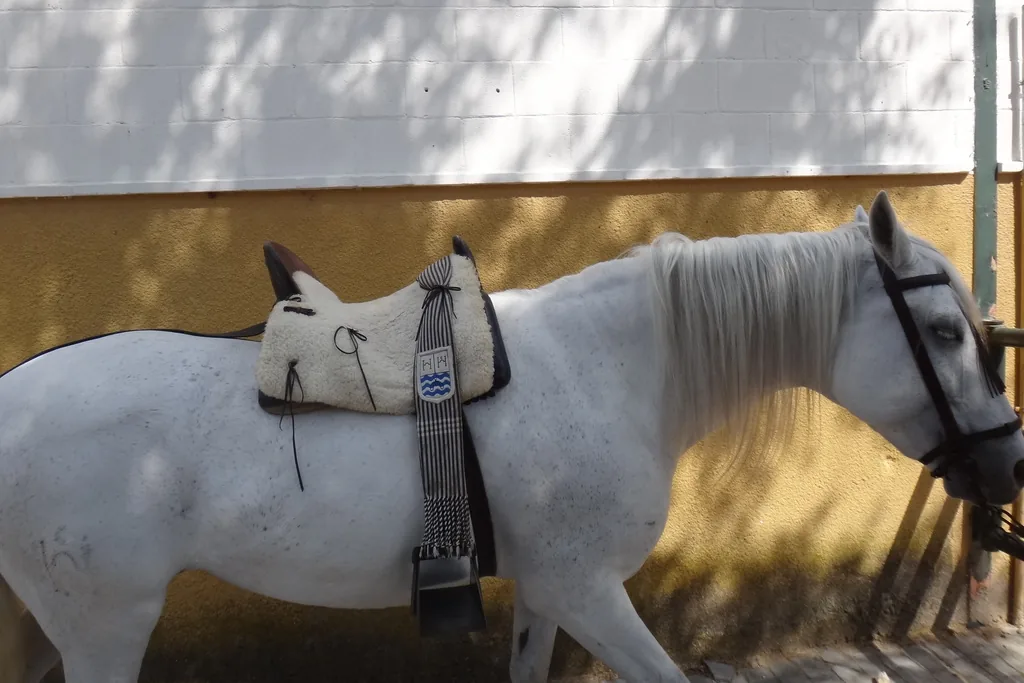
English Wikipedia says the breed is called the Andalusian or, in Spain, the Pura Raza Española, abbreviated PRE, meaning Pure Spanish Horse. The name comes from the region of Andalusia. Outside Spain, it says, the terms Andalusian and PRE are considered one and the same breed. Cartujano, or Carthusian, is the third name, and it points to the monks of Jerez rather than to a region.
Who keeps the studbook
Registration is less tidy than the names suggest. Wikipedia says the Spanish association ANCCE, recognised by Spain's Ministry of Agriculture, uses only the term PRE and treats terms such as Andalusian as referring only to crossbreds. It also notes that several competing registries disagree on definitions, purity standards and studbook rights. For a visitor the practical point is small: the horses you meet at the farm are registered Spanish horses of the Carthusian line, and the paperwork is not part of the tour.
Where Cartujano fits
Wikipedia calls the Carthusian horse a bloodline group within the Purebred Spanish horse, and its Andalusian article says the Carthusian is a subtype of the Andalusian, not a distinct breed in itself. The same article says the Carthusian is generally considered the purest Andalusian strain, and adds that no genetic evidence for the claim is known. A 2005 study, it says, found that the distinction between the two is not supported by genetic evidence. The line matters as history and as a studbook tradition.
Size and look
Wikipedia gives Spanish registration minimums of 15.0 hands for males and 14.3 hands for females. It lists the breed's traits as a strong, compact, elegant build, a thick mane and tail, and a straight or slightly convex profile. It says Carthusians in particular are lighter and more slender than other Purebred Spanish horses, with a relatively small, light head and a rather short, straight back. The same article calls the breed docile, intelligent and sensitive.
Colour: grey, and a note on foals
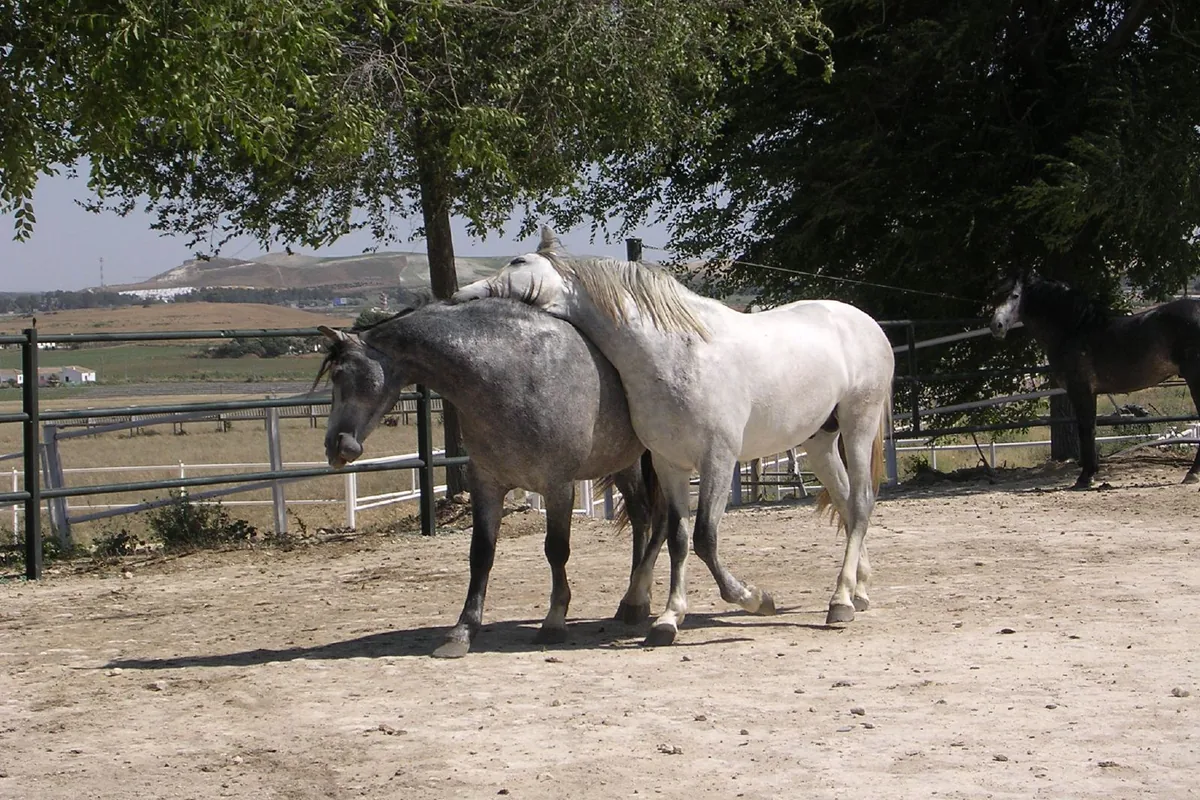
Wikipedia says that historically most colours occurred in the breed, including spotted patterns, but that grey dominates today. Of Carthusians it says they are predominantly grey. Its article on grey horses explains that grey horses are typically born a darker colour and lighten with age, which is why a foal beside its mother may look quite unlike her. A mixed group in an arena shows the whole range.
What the breed is used for
Wikipedia says Andalusians were among the first horses used in classical dressage, and that two Andalusians were on the Spanish dressage team that won bronze at the 2002 World Equestrian Games. It also lists other uses, including doma vaquera, stock work, driving, show jumping and western pleasure. The Spanish Ministry of Agriculture describes the Carthusian horse as especially suited to high-school dressage, and says the farm's visits close with an exhibition of the horse's qualities.
Read next: A stud-farm visit or a horse show: which suits you?
Who this isn't for
A reader who wants a genetic definition of the Carthusian horse will not find one here, because the sources say there is none. What the visit offers is a documented historic line, seen where it is kept.
Frequently asked questions
Is a Carthusian horse the same as an Andalusian?
Wikipedia says a Carthusian is a subtype of the Andalusian, not a distinct breed. Andalusian and Pura Raza Española name the same horse.
What colour are Carthusian horses?
Wikipedia says they are predominantly grey. Foals are typically born a darker colour and lighten with age.
Is the Carthusian line genetically distinct?
Wikipedia reports a 2006 study that found no genetic differences between Carthusian and other Purebred Spanish horses.
Sources