Which to choose
A stud-farm visit or a horse show: which suits you?
A stud-farm visit and a horse show both put Andalusian horses in front of you. What each gives you, who each suits, and how to choose around Jerez.
Book the Carthusian horse visit ↗Quick answer
Choose a stud-farm visit if you want to see how horses are bred, meet mares and foals at close range, and still end with a dressage exhibition. Choose a horse show if you would rather sit and watch a staged performance with little walking. The Carthusian visit near Jerez is both in one ticket: a guided tour, then a show. If you only want spectacle, ask any show provider what the performance contains before you book.
The two formats in a sentence each
Wikipedia defines a stud farm as an establishment for selective breeding of livestock, and traces the word stud to an Old English term for a herd of horses and a place where horses are kept for breeding. A visit to one is a walk through working yards. A horse show is something else: an arranged performance for a seated audience. Dressage, Wikipedia says, is a form of horse riding performed in exhibition and competition, which is why a stud farm can end its tour with one.
What a stud-farm visit gives you
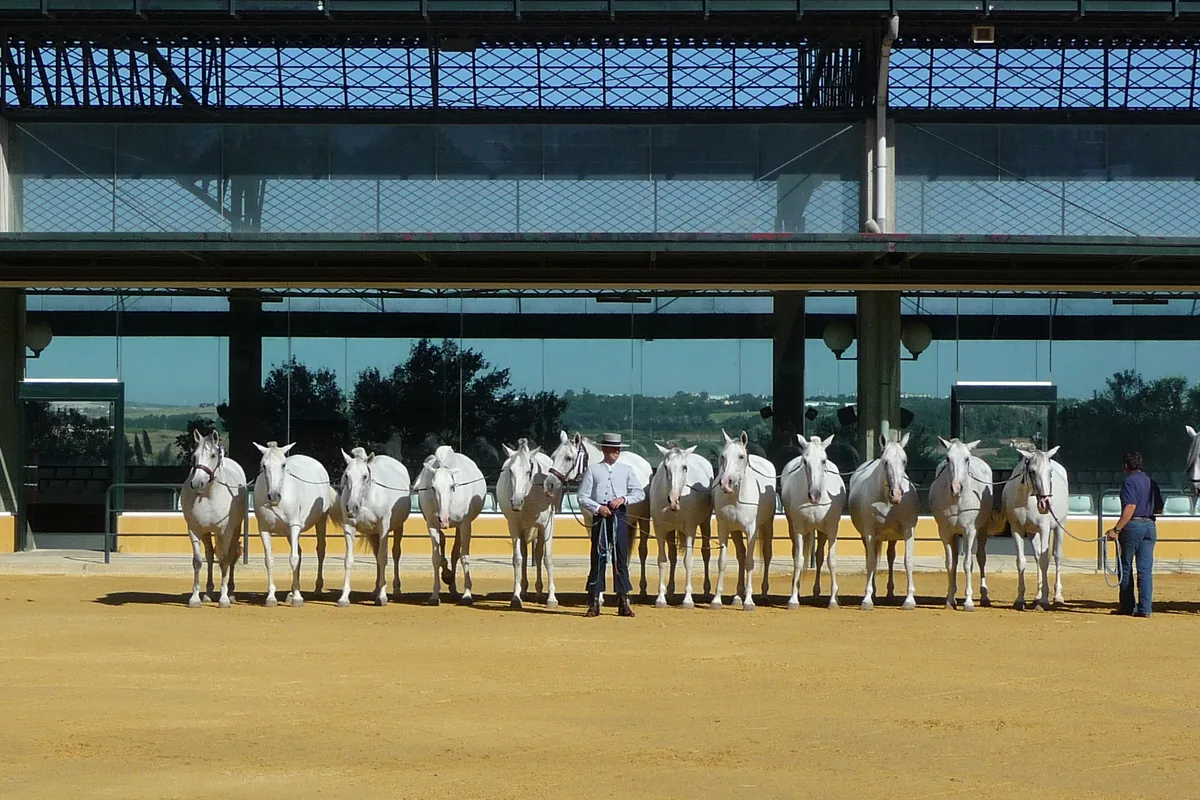
A stud farm is where mares, foals, colts and stallions live, so the visit shows the horse's everyday life rather than a rehearsed number. On the Carthusian tour near Jerez the booking page lists free-running colts, mares and stallions and this year's foals. The Ministry of Agriculture's description of the farm's visits adds the stallion yard, the mare barn, the historic tack room, the carriage museum and the stables, along with the veterinary clinic. Reviewers prize the close contact and the knowledgeable guides.
What a horse show gives you
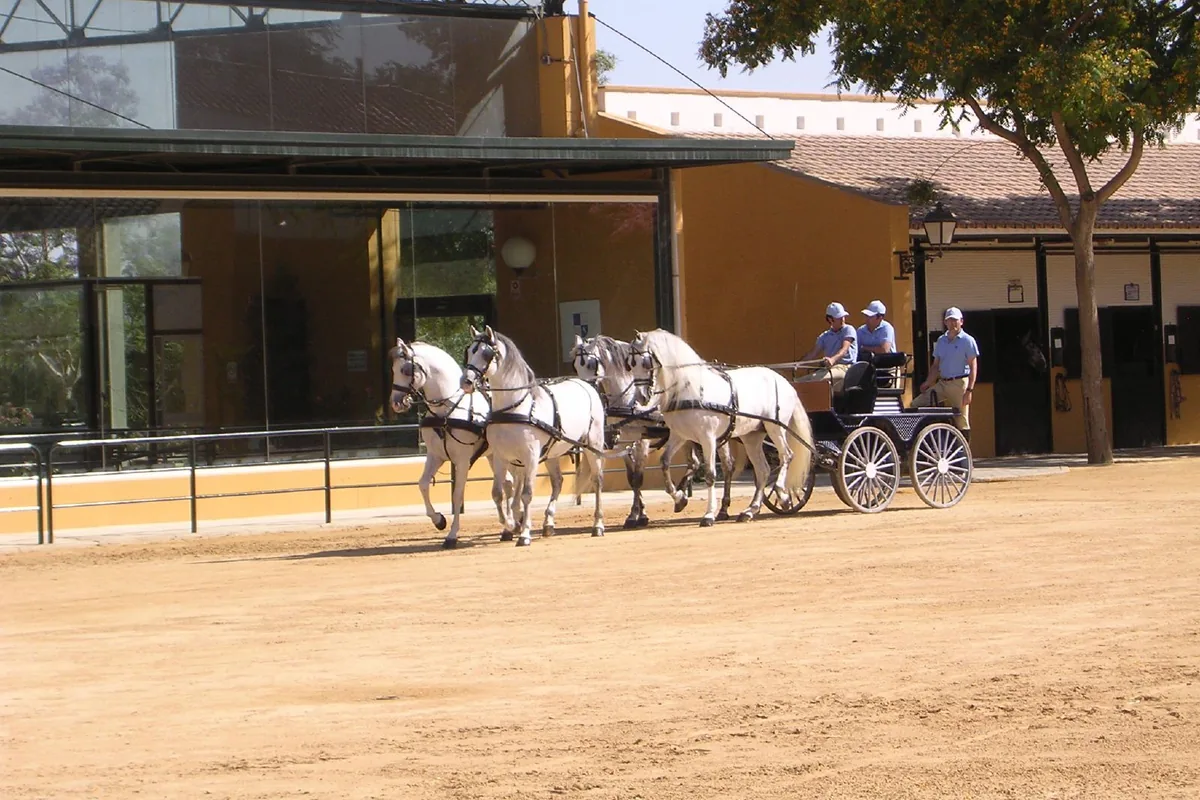
A show is built to be watched: a ring, seating, a programme with a beginning and an end. Wikipedia describes classical dressage as the tradition in which the training of the horse is pursued as an art form, and says Andalusians, Lusitanos and Lipizzans are most often trained for the airs, the high movements, because of their strong hindquarters. In Spain you may also meet doma vaquera, which Wikipedia calls the traditional working riding discipline of Spain, created in the 1970s. A show can lean on either style, so it is fair to ask which.
Where the two overlap
The Carthusian visit is not a pure stud-farm walk. The ministry says the farm's visits conclude with an equestrian exhibition to show off some of the qualities of the Carthusian horse, and the booking page promises a dressage exhibition in the main arena. A reviewer describes it as a guided visit followed by a lovely, varied show. So the choice is rarely tour or show. It is how much of the ticket should be tour and how much should be show, and whether you want the show in a country setting.
Pace, effort and comfort
A tour means standing and walking in groups, outdoors in the yards, so the booking page asks for comfortable shoes and comfortable clothes. A show usually means taking a seat. The Carthusian ticket covers tour and show together in roughly two and a half hours. The one complaint reviewers raise about the tour is sound: with a large group and low volume, the guide can be hard to hear, which a seated show avoids. Stand near the front and the problem eases.
Two riding styles you may meet
Dressage in Spain can mean more than one thing. Wikipedia sets doma vaquera apart from doma clásica, the classical Spanish school, and traces it to two older schools: a la brida, with long stirrups and straight legs, the typical technique of heavy cavalry, and a la jineta, with shorter stirrups and bent legs, the method of light cavalry. A stud farm's exhibition and a city show may each use either style, or a mix. If the style matters to you, the provider's own description is the place to check.
What a stud farm teaches that a show cannot
A show presents the finished horse. A stud farm shows the work behind it: mares with foals, young colts, stallions, a veterinary clinic and a laboratory. The Ministry of Agriculture says the farm works with it on the national programme for conserving and improving equine breeds, as a national reference centre for the sector. That is a different kind of interest from watching a rider, and it is the reason some travellers prefer the visit even when the show is short.
Side by side
None of these formats replaces the others, because each answers a different question about what you want from the horses. The table keeps to what the sources state and leaves out prices, so you can compare shape first.
Stud-farm visit and horse show compared
| Format | What you do | Best for |
|---|---|---|
| Stud-farm visit | Walk the yards with a guide, then watch an exhibition | Curious travellers and horse lovers |
| Horse show | Sit and watch a staged programme | Travellers who want a spectacle with little walking |
| Visit that ends in a show | Both, in one ticket | Anyone undecided |
Families and people who are not horse people
Travellers who say they are not horse people still rate the Carthusian visit. One writes that neither of them was particularly into horses but they really enjoyed it, and another says the interaction with the horses and the show made hearts beat faster, and that it was not only their daughter who was happy. Those are individual reviews, not a promise of how any child will react. The booking page states no age limit, so ask the provider if your party includes very young children.
Doing both in one stay
Nothing stops you booking a stud-farm visit one day and a show on another, and for a long stay in Jerez that is a reasonable plan. Each ticket has its own start times and its own cancellation window, so check both calendars before you pay for either. Because the Carthusian ticket already ends in a dressage exhibition, a second show is optional rather than needed. If you do add one, ask what it contains, so that the two do not repeat each other.
Questions to ask any provider
Whatever you choose, a few questions are worth settling before you pay, because the answers differ from place to place:
- Which languages does the guide or presenter use?
- Is the dressage classical, or is it a working-style display?
- How long is the show itself, as opposed to the whole ticket?
- Will you stand or sit, and will you be in sun or shade?
- Is the ground suitable for wheelchairs and pushchairs?
- What may you photograph or film?
A quick way to decide
Start from what you would hate to miss. If it is seeing foals, mares and stallions in the place where they live, book the stud-farm visit. If it is a polished performance with a seat for the whole time, find a show and check its style. If you cannot decide, the Carthusian ticket covers both in roughly two and a half hours, and nothing is lost if you cancel before the day of the visit, so a wrong guess is cheap to fix.
Read next: What is a Carthusian horse, and what happens at the stud farm?
Who this isn't for
A stud-farm visit is a poor fit if you want to be seated throughout, if you need dinner or drinks as part of the evening, or if you want to ride. A show is a poor fit if what you want is the working side of horse breeding. Travellers without a car should also weigh the journey: the Carthusian farm lies outside Jerez on a country road, which the guide to getting there covers.
Read next: Getting to the stud farm from Jerez
Frequently asked questions
Is a stud-farm visit better than a horse show?
Neither is better. A stud-farm visit shows how horses live and are bred; a horse show is a performance. The Carthusian ticket near Jerez combines a guided tour with a dressage show.
What is dressage?
Wikipedia calls it a form of horse riding performed in exhibition and competition. Classical dressage treats the horse's training as an art form.
Does the Carthusian visit include a show?
Yes. The booking page lists a dressage exhibition in the main arena, and the Ministry of Agriculture says the farm's visits end with an equestrian exhibition.
How long does the visit take?
The booking page gives roughly two and a half hours for the whole ticket, tour and show together.
Is it suitable for people who are not horse lovers?
Some reviewers who say they are not particularly into horses still rate it highly. Ask the provider about very young children.
Can I change my booking?
Yes: a booking can be dropped without charge until the day before, and you may pay afterwards.
Sources